
KEY TAKEAWAY
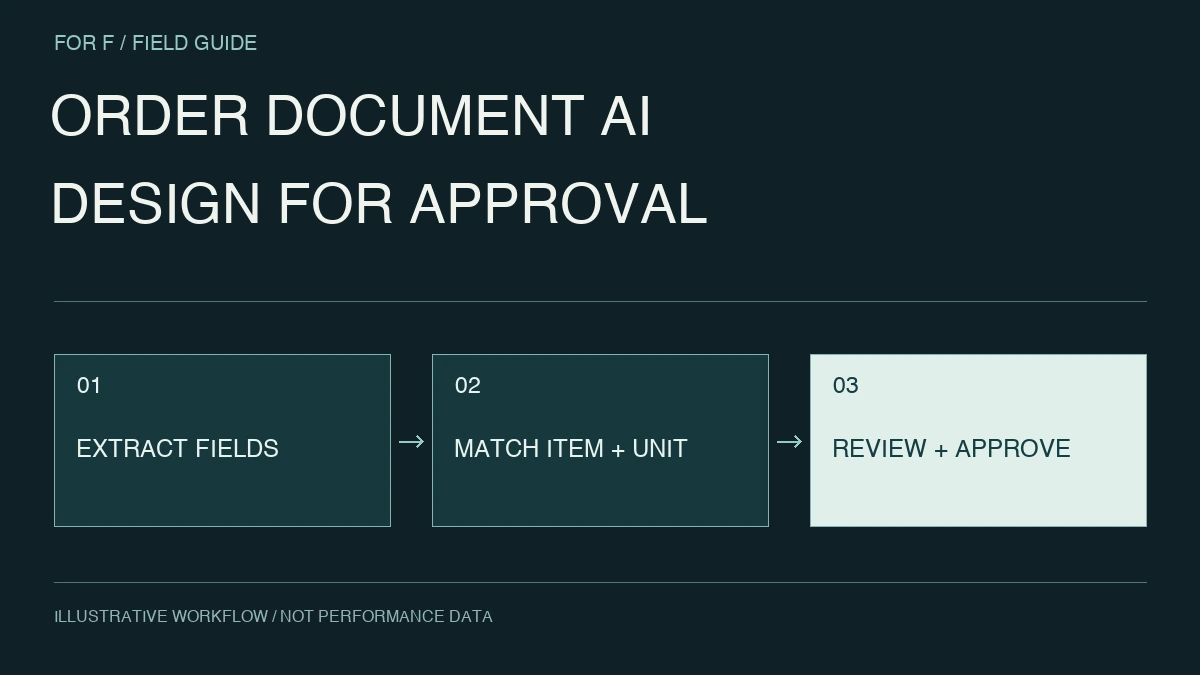
Separate originals, extraction, master matching, approval and registration. Define who resolves exceptions and how before treating OCR output as an order.
1. Correct text can still mean a wrong order
Recognizing “10” does not resolve whether it means units or cases. Customer aliases and identifiers also require business matching. Evaluate complete lines with the correct product, quantity and unit.
Extraction confidence does not guarantee commercial correctness. Define field-level review criteria using your own documents.
2. Keep difficult examples in evaluation
Include faded faxes, stamps, handwriting, multiple pages and wrapped lines, weighted by real customer volume and difficulty.
Keep tuning and evaluation documents separate and test unfamiliar layouts and products. A success-only demo cannot establish exception-handling cost.
3. Assign product-matching ownership
Maintain manufacturer, internal and customer identifiers alongside specification and pack size. Route ambiguous lines to review and version any approved reusable mappings.
Separate product questions from pricing and delivery questions so exceptions reach the team that can resolve them.
4. Test resends, amendments and failures
Duplicate faxes, later revisions and missing registration responses require duplicate-safe processing. Track intake IDs, order numbers and revision states separately.
Operators must be able to determine whether registration succeeded. Test retries in a non-production destination and verify that another order is not created.
5. Measure through approval
Fast extraction does not help if review effort rises. Measure active work through approval and registration together with incorrect-order counts. Inspect the work required per exception, not only the automatic-processing share.
Begin with selected customers or formats where value is demonstrated, then expand.
6. Prepare a useful commissioning brief
Sample originals, monthly and peak volumes, product masters, entry destinations and amendment procedures help define scope. Check supported CSV imports before considering other integration methods.
For f can separate document evaluation, review interfaces and ERP integration into clear engagements. Establish human confirmation points even when the first phase covers extraction only.
A concrete acceptance check
Acceptance checks whether reviewers can stop wrong quantities, units and duplicate orders. High extraction accuracy alone does not pass if unapproved records can be registered.
Before commissioning
- Evaluate product, quantity and unit together.
- Assign review owners by exception reason.
- Test duplicates, amendments and retries.
- Measure effort through completed approval.
Explore support for this industry
Wholesale and trading — data and AI overview ↗