Connect knowledge and delivery across your organization.
Connect documents and delivery information across consulting, research, creative and outsourced services. Build project contribution reporting and knowledge AI with client boundaries.
Conceptual data-to-operation flow, adapted to the agreed project scope.
Start with the operating model. Find the right problem.
In knowledge-intensive work, searching, waiting and unplanned revisions can be invisible. Make scope and delivery flow understandable before drawing conclusions about individual performance.
For these teamsBusiness leaders, project management, consulting, creative and BPO teams
01 / INPUTS
Project management and CRM
Time, billing and subcontracting
Proposals, procedures and deliverables
02 / CONTEXT
Apply client boundaries
Align scope and time, preserving the path to source records.
An illustrative path from data to decisions. Interfaces, access and evaluation depend on the agreed scope.
PRIORITY WORKFLOWS
Choose the work to improve first.
01 / CAPABILITY
Project contribution and effort analytics
Billing and delivery periods can differ. Map contracts, projects and stages, separating additional scope from included revisions.
Connect scope, planned and actual effort, subcontracting and billing. Make contribution and progress traceable while distinguishing missing entries from estimates.
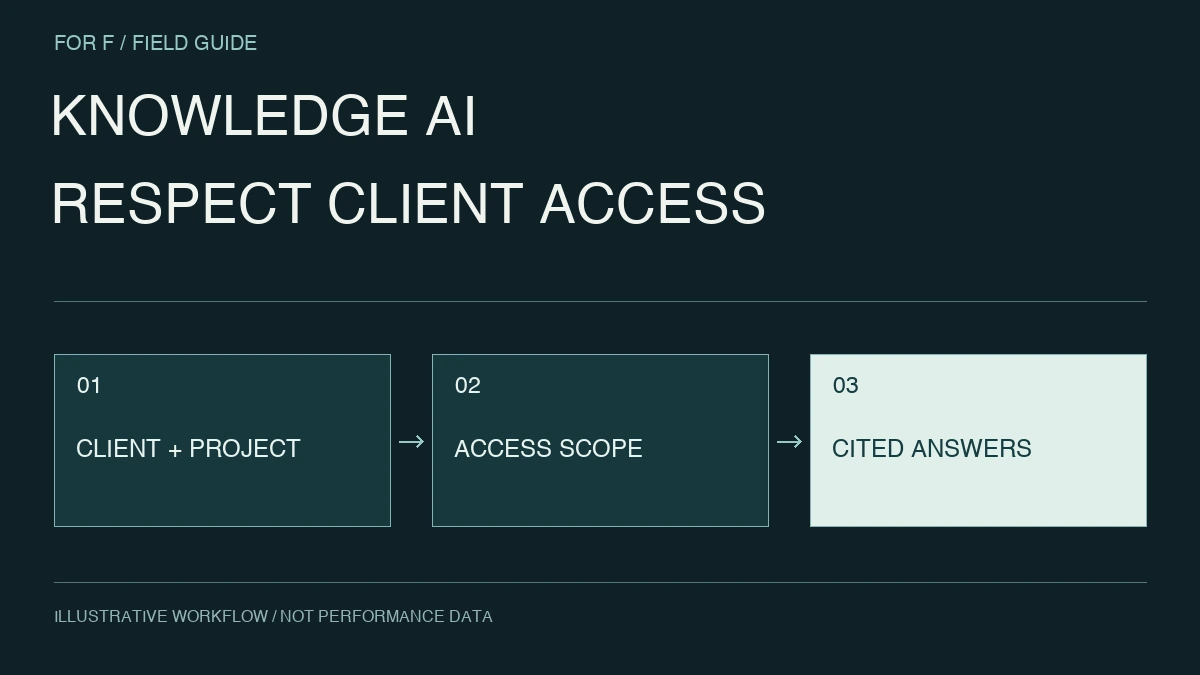
Searchability does not imply permission to reuse material for another client. Distinguish internal, client-restricted and reusable knowledge, retaining source and revision.
Organize proposals, procedures and research by client, project and permitted use. Build retrieval and drafting around evidence that may legitimately be reused.
Start with existing information. Design the connections.
Before adding systems, identify sources, access methods and refresh owners. CSV and existing reports can establish value before committing to integrations.
01Project management and CRM
Separate clients and projects, mapping scope, dates and teams instead of joining documents by client name alone.
02Time, billing and subcontracting
Check entry/work dates and approval states; distinguish missing time from zero effort and retain corrections.
03Proposals, procedures and deliverables
Identify current versions, permitted uses and post-project access, applying the same rules to search.
Align project, document and time identifiers, adjust access when work ends, and apply the same client boundaries to indexes and logs.
This is an illustrative engagement, not a client case study or a claim of results.
Consider a team spending too long finding prior proposals and service records. Start with selected completed projects and separate reusable material from client-specific restricted content.
Prototype answers beside source documents and pages, with retrieval scoped to user permissions. For unsupported questions, test abstention and an escalation path.
What this prototype delivers
Ask identical questions with test users holding different access scopes. Check citations, retrieval results and cached material as well as the answer text for unintended exposure.
Useful inputs for an initial discussion
Sample proposals and procedures with permitted-use boundaries
Access mappings for clients, projects and users
Examples of frequent questions and questions that must remain unanswered
The set does not need to be complete; discovery can establish missing inputs and access conditions.
DISCOVER → PROVE → BUILD
Can verification and drafting effort fall while client information stays separated?
Choose one team and project type for reporting or internal retrieval.
01
Client separation
Use similar topics from different clients to test each user’s scope.
02
Missing evidence
Test absent effort entries and unsupported questions for misleading certainty.
03
Measure completed work
Compare time through human review, not generation speed alone.

 PROFESSIONAL SERVICES / OVERVIEW