Connect production, inspections and equipment events by product, process and lot. Build data and AI workflows for daily reporting, quality investigations and maintenance priorities.
Conceptual data-to-operation flow, adapted to the agreed project scope.
Start with the operating model. Find the right problem.
Process conditions and quality outcomes often live in separate systems. Start with the evidence people reconcile during an investigation, and build analysis around production that must keep running.
For these teamsPlant managers, production planning, quality, engineering and IT
01 / INPUTS
Production and MES records
Inspection and defect categories
Equipment and maintenance logs
02 / CONTEXT
Align lots and timestamps
Align scope and time, preserving the path to source records.
An illustrative path from data to decisions. Interfaces, access and evaluation depend on the agreed scope.
PRIORITY WORKFLOWS
Choose the work to improve first.
01 / CAPABILITY
Production and quality data
Daily reports, lot inspections and second-level sensor logs have different grains. Joining them directly can multiply rows and distort defect rates or downtime. Define the mapping from work order to finished lot first.
A data foundation for investigating quality variation: align quantities, process conditions and inspection results before designing the dashboard.
Rare failures can leave too few labelled examples for reliable validation. Compare against existing threshold monitoring and identify where AI adds value.
Test whether equipment and maintenance records can identify changes worth investigating. Evaluate false alarms, review effort and actionable lead time alongside detection performance.
Start with existing information. Design the connections.
Before adding systems, identify sources, access methods and refresh owners. CSV and existing reports can establish value before committing to integrations.
01Production and MES records
Confirm work orders, actual quantities and process codes. Define counting units so work in progress is not counted as finished output.
02Inspection and defect categories
Capture methods, acceptance rules and reinspection history alongside measurements. Distinguish lots that were never inspected.
03Equipment and maintenance logs
Check equipment IDs, time zones, sampling intervals and maintenance times. Separate genuine stops from missing logs.
Start with read-only analytical feeds. Agree on factory-network boundaries, refresh intervals and maintenance windows before connecting orders and inspections.
Remove one reconciliation step from quality investigations.
This is an illustrative engagement, not a client case study or a claim of results.
Consider a quality team searching separate daily reports, inspections and equipment histories for a defective lot. Trace its current investigation and list source records and the keys connecting them.
A prototype lets a user select a lot, inspect process conditions and test results, then open supporting records. Evaluate unmatched records and double counting as well as investigation time. Automatic root-cause attribution is outside this example.
What this prototype delivers
At acceptance, compare with results reconciled by quality staff using the existing procedure. Include product changes, retests and missing records, and require the user to explain findings from source evidence.
Useful inputs for an initial discussion
Sample anonymized work orders, inspections and maintenance records
Lot, equipment and process code mappings with data owners
A current investigation workflow and its completion criteria
The set does not need to be complete; discovery can establish missing inputs and access conditions.
DISCOVER → PROVE → BUILD
Can the team assemble useful investigation evidence sooner than with the current workflow?
Select one line or asset group and one goal: quality investigation or anomaly notification.
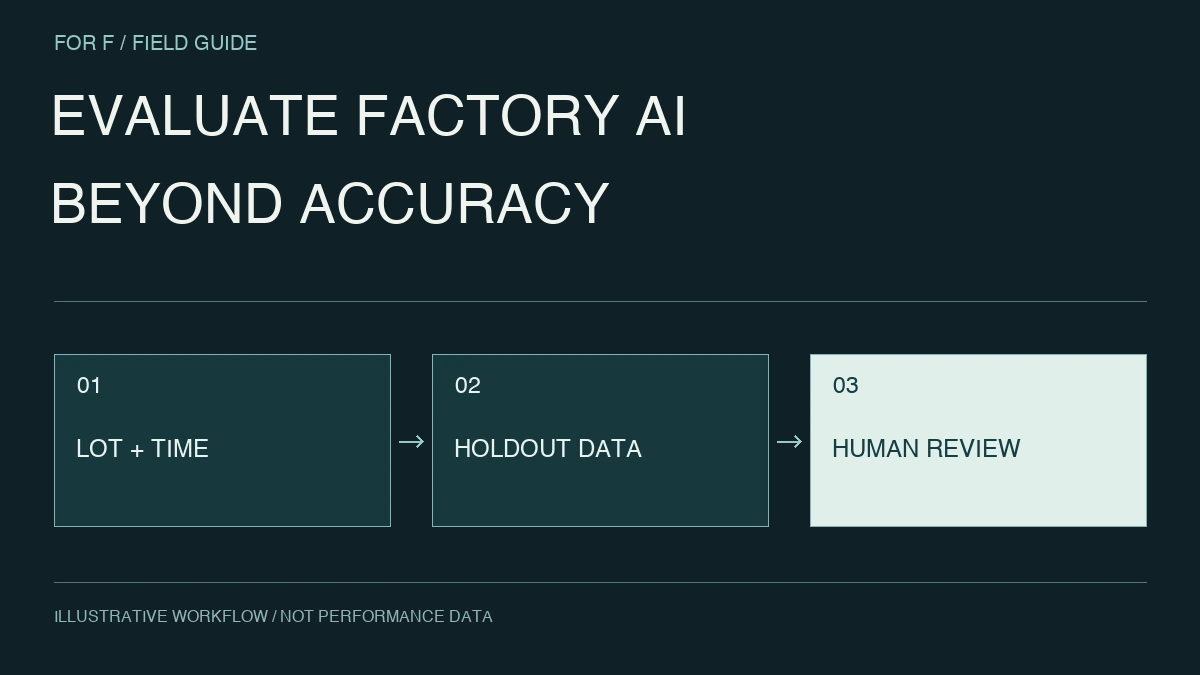
01
Separate past and future
Use a later holdout period and prevent closely related records from the same lot leaking between sets.
02
Check equipment differences
Review results by operating condition, product change and maintenance state.
03
Reproduce on the floor
Ask operators to inspect source records and explain the alert and next action.

 MANUFACTURING / OVERVIEW