
KEY TAKEAWAY
Define when, on which lots or assets, and by whom a decision will be made. Separate misses, false alerts and review time to establish usable production acceptance criteria.
1. Why a strong score may not help the plant
When normal records dominate, predicting normal can produce an impressive overall score. Operators need changes that warrant action at a useful time. An evaluation brief should separately record detected events, missed events and false notifications.
A small number of alerts can still be expensive if each requires several systems to investigate. Review the source-evidence workflow alongside the numerical score.
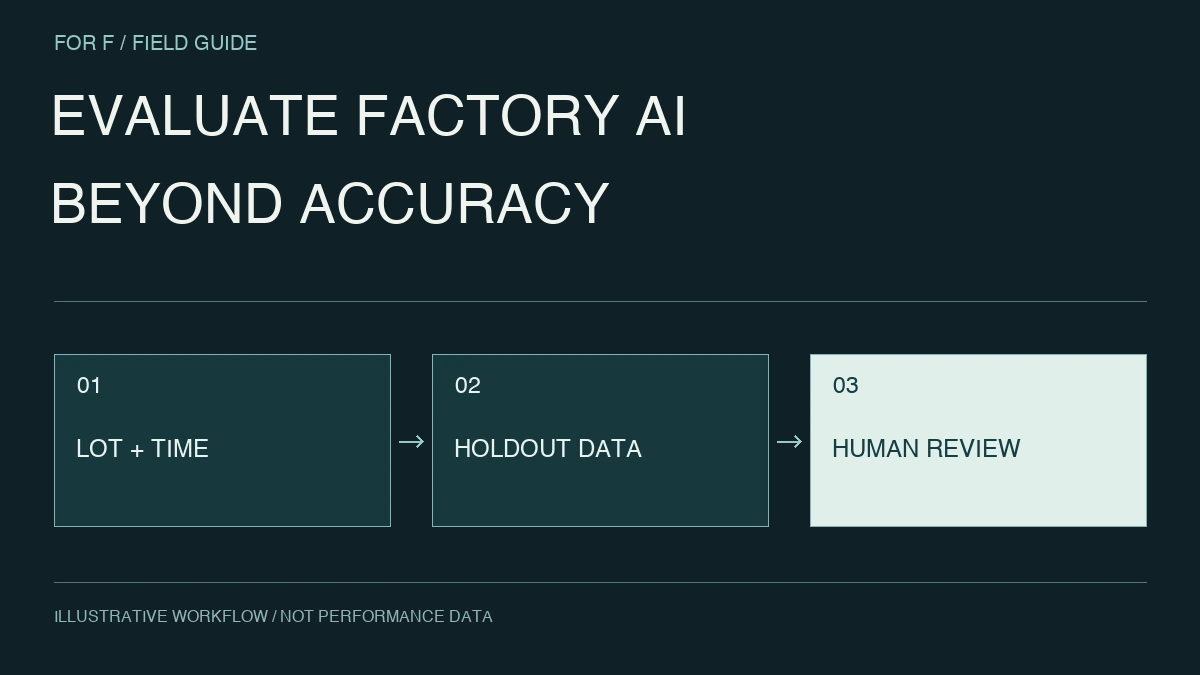
2. Align lots and timestamps first
A lot-level inspection joined to second-level equipment records can be duplicated across many rows. Define order, process and lot relationships and the time window relevant to an outcome. Check clock drift across systems.
When a lot crosses several processes, its final defect should not automatically be attributed to every process. Association is a lead for investigation, not proof of causation.
3. Keep future information out of evaluation
A defect category finalized after inspection or replacement reason recorded after failure can leak the answer into an earlier prediction. Check when each field became available and use only information known at the decision time.
Random row splits can put the same lot or adjacent readings into training and evaluation. Consider time, lot and asset boundaries to test conditions closer to future use.
4. Evaluate what happens after the alert
Give operators the alerts and original records and ask them to explain whether investigation is needed and what happens next. Missing evidence or ownership cannot be solved by model accuracy alone.
Record whether an alert came from a true event, a normal operating transition or a data issue. This separates improvements to the model, capture process and review interface.
5. Specify the evaluation deliverables
Specify periods, assets, products, baseline methods, exclusions and aggregation units. Request failures, inconclusive cases and reproducible evaluation procedures, not only successful demos.
With too few events, predictive value may remain unproven. Data collection and better event records can be valid next deliverables without claiming the benefits of a production model.
6. Define the production decision
Production readiness also includes reevaluation after equipment changes, failed-refresh alerts and review capacity. Control integration such as automatic shutdown has additional requirements and should be scoped separately.
For f can help define data preparation and focused validation. Sample records and the documents used in current investigations help make the evaluation specific.
A concrete acceptance check
At acceptance, compare with results reconciled by quality staff using the existing procedure. Include product changes, retests and missing records, and require the user to explain findings from source evidence.
Before commissioning
- Use only fields available at decision time.
- Separate evaluation by lot, asset and period.
- Measure false alerts and review effort.
- Document inconclusive conditions and the next investigation.
Explore support for this industry
Manufacturing — data and AI overview ↗