 MANUFACTURING / BUILD & OPERATE
Ownership and recovery
Assign refresh failures to IT and result review to production or quality owners.
 TECHNOLOGY & DESIGN
MANUFACTURING / BUILD & OPERATE
Start with read-only analytical feeds. Agree on factory-network boundaries, refresh intervals and maintenance windows before connecting orders and inspections.
Explore the delivery scope ↓Conceptual data-to-operation flow, adapted to the agreed project scope.
Start with read-only analytical feeds. Agree on factory-network boundaries, refresh intervals and maintenance windows before connecting orders and inspections.
Assign refresh failures to IT and result review to production or quality owners.
Recheck definitions and evaluation when products, assets or inspection criteria change.
Reconcile one line before expansion, then revisit codes and conditions across plants.
PRODUCTION SCOPE
| Scope | Industry context | Agreement |
|---|---|---|
| Data integration | Production and MES records / Inspection and defect categories / Equipment and maintenance logs | Refresh, retry, deduplication and reconciliation |
| Interfaces and access | Plant managers, production planning, quality, engineering and IT | Read, edit and approve permissions with activity records |
| Migration and acceptance | Select one line or asset group and one goal: quality investigation or anomaly notification. | Parallel verification, scoped record counts and rollback |
ARCHITECTURE CHOICES
Compare extending existing databases and business tools with cloud foundations including Snowflake and Google Cloud. Evaluate volume, refresh, access, interfaces and operating cost before choosing products.
Ingest and reconcile operating records before deciding whether write-back is needed.
Show failed refreshes, unmatched data and pending reviews with source and recovery paths.
Separate compute, storage and API cost drivers and agree on refresh and usage scope.
RELEASE READINESS
Can the team assemble useful investigation evidence sooner than with the current workflow?
Test missing or late data, integration failures and unavailable owners, including notifications, recovery and manual fallback.
Agree on architecture, configuration, access, refresh and recovery documentation, with defined monitoring hours and improvement scope.
Interfaces, export terms, volumes, history, users, permissions and timing make estimates concrete. If these are unknown, scope discovery as an initial engagement.
Process conditions and quality outcomes often live in separate systems. Start with the evidence people reconcile during an investigation, and build analysis around production that must keep running.
QUESTIONS BEFORE YOU START
Yes. Start with production and inspection reconciliation. Predictive maintenance needs a separate assessment of sampling and event history.
No fixed reduction is promised. First validate traceability and investigation effort, then evaluate quality interventions through plant trials.
RELATED FIELD GUIDE
MANUFACTURING / GUIDE
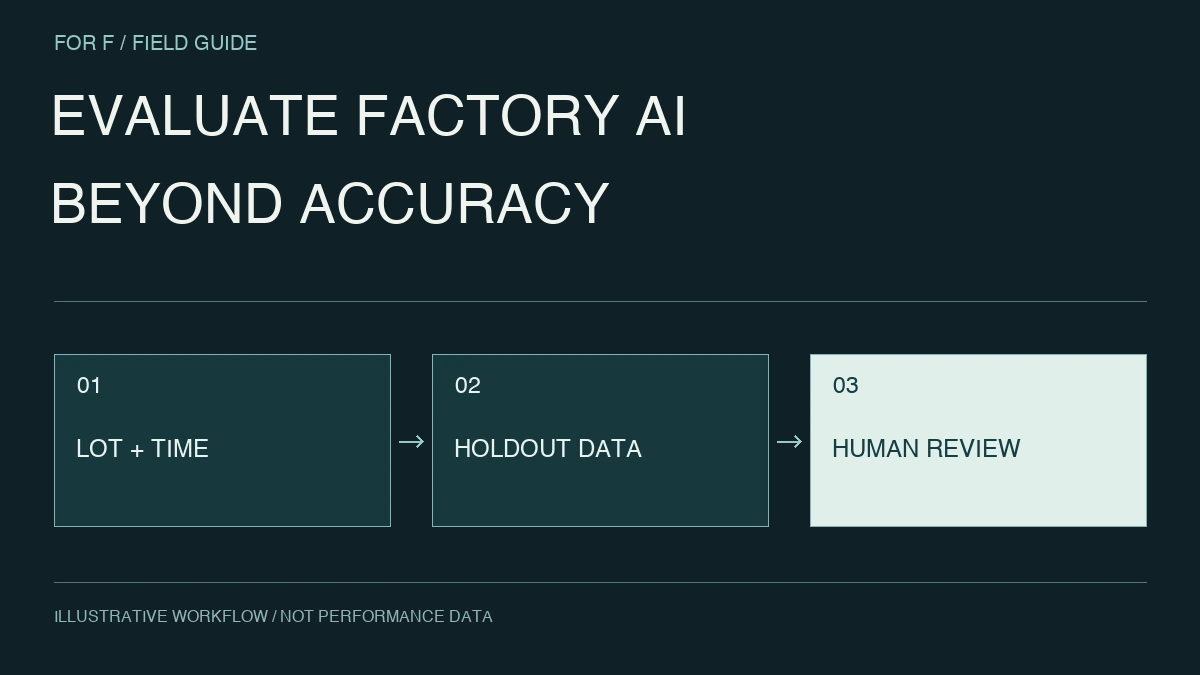
Before commissioning factory AI, define how evaluation data is separated and how operators will review results. This guide explains common pitfalls and a practical evaluation brief.
Read the guide ↗YOUR OPERATION / OUR STARTING POINT
Tell us about the workflow, systems and reporting or documents that need attention. We will define a suitable phase, deliverables and assumptions.
Manufacturing — discuss your project How scope and estimates work ↗