 MANUFACTURING / CAPABILITY
Separate operating states
Startup, steady operation, product changeovers and post-maintenance conditions can give the same reading different meanings.
 TECHNOLOGY & DESIGN
MANUFACTURING / CAPABILITY
Test whether equipment and maintenance records can identify changes worth investigating. Evaluate false alarms, review effort and actionable lead time alongside detection performance.
Explore the delivery scope ↓Conceptual data-to-operation flow, adapted to the agreed project scope.
Rare failures can leave too few labelled examples for reliable validation. Compare against existing threshold monitoring and identify where AI adds value.
THE SHORT ANSWER
Test whether equipment and maintenance records can identify changes worth investigating. Evaluate false alarms, review effort and actionable lead time alongside detection performance.
DESIGN & DELIVERY
Startup, steady operation, product changeovers and post-maintenance conditions can give the same reading different meanings.
An accuracy score can look strong when normal samples dominate. Track detected events and unnecessary notifications independently.
Record confirmed causes, dismissed alerts and replacements. Maintain an evaluation set for comparing model versions.
DATA READINESS
A consistent format does not ensure operational usefulness. Confirm meaning, refresh and exceptions with owners, and keep missing information explicit.
| Data | Required fields | Checks |
|---|---|---|
| Time series | Vibration, temperature, current and sampling interval | Missing data versus operating modes |
| Maintenance | Occurrence, discovery and replacement times | Uncertain event onset |
| Asset register | Model, location and change history | Treating replaced equipment as the same asset |
EVALUATION
These are candidate evaluation measures. Establish a baseline and agree on data, period, targets and exclusions before work starts. They are not claimed performance results.
| Measure | Evaluation method |
|---|---|
| Alert workload | Notifications requiring review per asset per day |
| Actionable lead time | Time available before intervention is needed |
| Useful detections | In-scope events detected within the agreed window |
Automated shutdown and safety controls require separate engineering. Initial scope is notification and investigation that support operator decisions.
Review data mappings, workflow, prototype and evaluation evidence before choosing production scope. Estimates distinguish assumptions because permissions and interface terms affect implementation.
Select one line or asset group and one goal: quality investigation or anomaly notification.
QUESTIONS BEFORE YOU START
Yes. Start with production and inspection reconciliation. Predictive maintenance needs a separate assessment of sampling and event history.
No fixed reduction is promised. First validate traceability and investigation effort, then evaluate quality interventions through plant trials.
RELATED FIELD GUIDE
MANUFACTURING / GUIDE
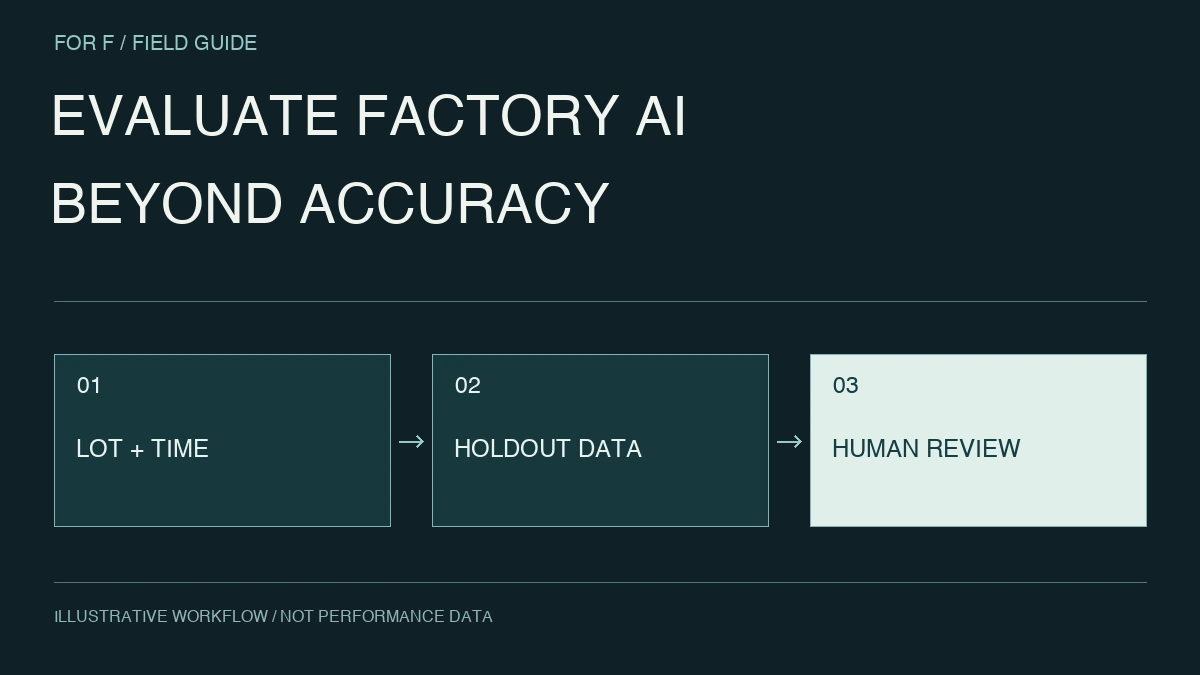
Before commissioning factory AI, define how evaluation data is separated and how operators will review results. This guide explains common pitfalls and a practical evaluation brief.
Read the guide ↗YOUR OPERATION / OUR STARTING POINT
Tell us about the workflow, systems and reporting or documents that need attention. We will define a suitable phase, deliverables and assumptions.
Manufacturing — discuss your project How scope and estimates work ↗