
KEY TAKEAWAY
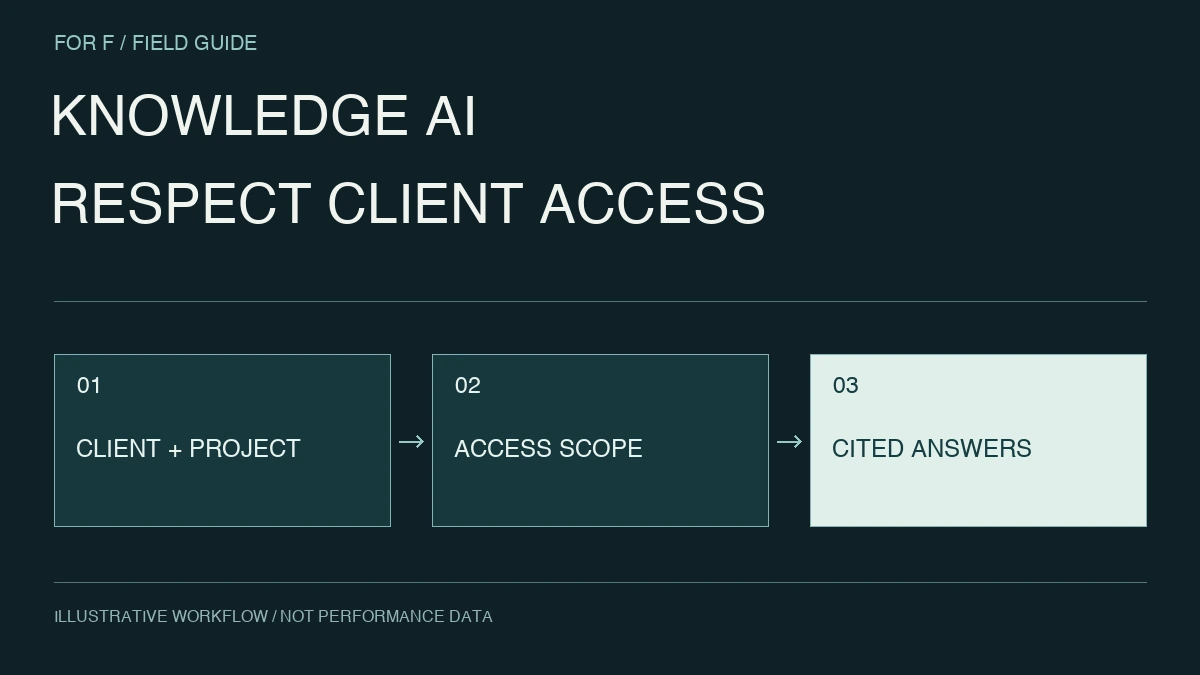
Define client, project and reuse boundaries before indexing a shared drive. Apply them consistently to retrieval, answers, source documents and logs.
1. Searchable does not mean reusable
An internally stored proposal is not necessarily reusable for another client. Check confidentiality, contractual handling and third-party material, separating general methods and public information. Removing a client name alone may not remove identifying context.
Internal procedures and approved generic templates can be a manageable first collection.
2. Map clients, projects and users
Folders can be moved or copied. Attach client, project, owner and permitted-use metadata and scope retrieval to the user and current task. Multi-client staff should make their working context explicit.
Define access reviews after transfers, departures and project closeout, rather than allowing historical access to persist.
3. Keep claims tied to evidence
Plausible numbers and examples cannot be submitted without evidence. Show sources, passages and versions and mark unsupported content for review. Check names and case-study attribution.
Some teams benefit more from outlines and retrieval than complete drafts. Evaluate usability rather than output length.
4. Test requests that cross boundaries
Use similar material from different clients to test unauthorized requests. Ambiguous references to a previous project should not silently select a client context.
Check result titles, links and logs as well as answer text. Separate normal, unauthorized, missing-evidence and conflicting-source tests.
5. Measure through human review
Fast generation can be offset by source verification and corrections. Measure search, drafting, editing and review separately to see where effort moves.
Compare tasks of similar difficulty and record differences in experience and source completeness. Use this to improve workflows rather than automatically rank people.
6. Include ownership and updates in the brief
Specify collections, users, access, evaluation questions, draft purpose and external-release approval. Include refresh and deletion handling and a way to report problematic answers.
For f can validate client-scoped information, retrieval and drafting in stages. A document inventory and current search bottlenecks help define the initial scope.
A concrete acceptance check
Ask identical questions with test users holding different access scopes. Check citations, retrieval results and cached material as well as the answer text for unintended exposure.
Before commissioning
- Separate client-specific and reusable knowledge.
- Test access changes after reassignment and closeout.
- Verify draft claims in source documents.
- Compare effort through completed review.