 PROFESSIONAL SERVICES / CAPABILITY
Reuse boundaries
Separate client information from general methods and agree on sharing rules.
 TECHNOLOGY & DESIGN
PROFESSIONAL SERVICES / CAPABILITY
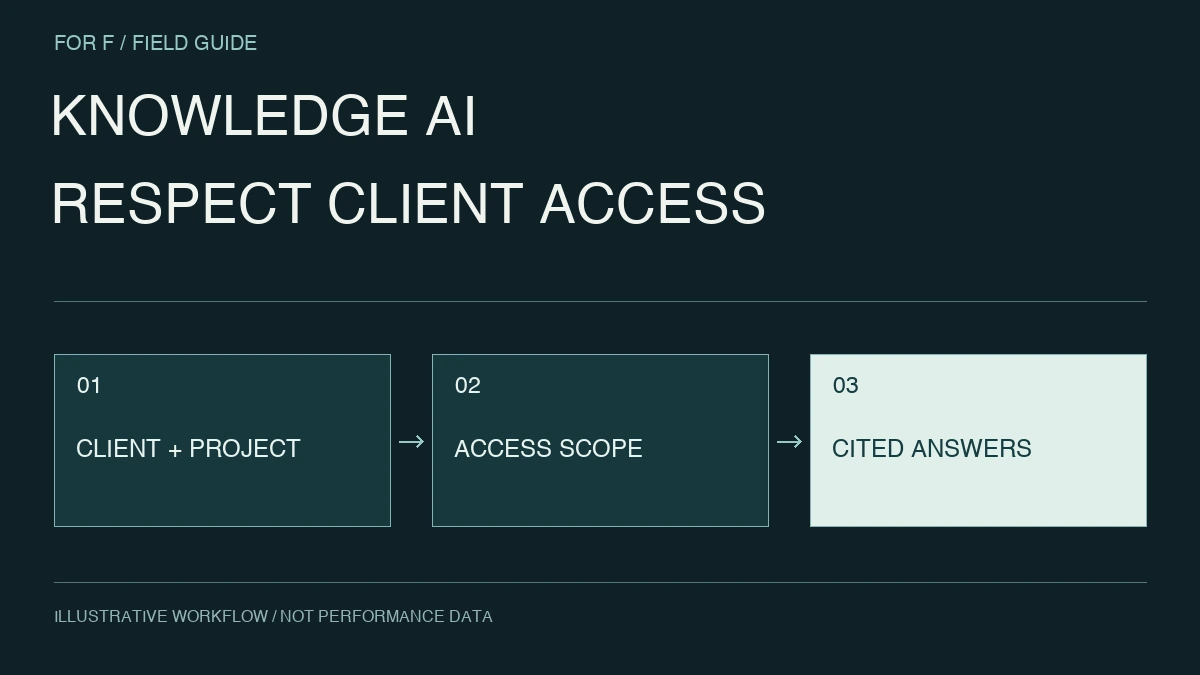
Organize proposals, procedures and research by client, project and permitted use. Build retrieval and drafting around evidence that may legitimately be reused.
Explore the delivery scope ↓Conceptual data-to-operation flow, adapted to the agreed project scope.
Searchability does not imply permission to reuse material for another client. Distinguish internal, client-restricted and reusable knowledge, retaining source and revision.
THE SHORT ANSWER
Organize proposals, procedures and research by client, project and permitted use. Build retrieval and drafting around evidence that may legitimately be reused.
DESIGN & DELIVERY
Separate client information from general methods and agree on sharing rules.
Propose structures and discussion points with traceable sources.
Staff check quality, quotations, numbers and client names; missing evidence stays marked for review.
DATA READINESS
A consistent format does not ensure operational usefulness. Confirm meaning, refresh and exceptions with owners, and keep missing information explicit.
| Data | Required fields | Checks |
|---|---|---|
| Material | Client, project, revision and owner | Non-reusable content |
| Example requests | Draft goals and required evidence | Requests for unsupported numbers |
| Access | Client assignment, team and contract end | Multiple roles and staff transfers |
EVALUATION
These are candidate evaluation measures. Establish a baseline and agree on data, period, targets and exclusions before work starts. They are not claimed performance results.
| Measure | Evaluation method |
|---|---|
| Client isolation | Prevent cross-client retrieval and answers |
| Evidence checks | Verify draft claims against source material |
| Editing effort | Time to turn the draft into a deliverable |
AI does not independently send proposals or make commitments. Document permissions and release approval follow the delivery process.
Review data mappings, workflow, prototype and evaluation evidence before choosing production scope. Estimates distinguish assumptions because permissions and interface terms affect implementation.
Choose one team and project type for reporting or internal retrieval.
QUESTIONS BEFORE YOU START
Yes. Scope one report or document set and use existing tools where suitable.
First establish sharing and reuse conditions, then separate client access and collections.
RELATED FIELD GUIDE
PROFESSIONAL SERVICES / GUIDE
Before using past proposals and operating documents, distinguish client-specific information from reusable knowledge. Scope permissions, source-backed drafts and human review.
Read the guide ↗YOUR OPERATION / OUR STARTING POINT
Tell us about the workflow, systems and reporting or documents that need attention. We will define a suitable phase, deliverables and assumptions.
Professional services and BPO — discuss your project How scope and estimates work ↗