 WHOLESALE & TRADING / BUILD & OPERATE
Exception owners
Route product, price and delivery questions to the appropriate teams.
 TECHNOLOGY & DESIGN
WHOLESALE & TRADING / BUILD & OPERATE
Track receipt, storage, review and ERP status under a single intake ID. Use duplicate-safe retry keys and an operator reprocessing interface.
Explore the delivery scope ↓Conceptual data-to-operation flow, adapted to the agreed project scope.
Track receipt, storage, review and ERP status under a single intake ID. Use duplicate-safe retry keys and an operator reprocessing interface.
Route product, price and delivery questions to the appropriate teams.
Update extraction and evaluation documents when customers revise layouts.
Start with drafts before registration and agree on expansion using review outcomes.
PRODUCTION SCOPE
| Scope | Industry context | Agreement |
|---|---|---|
| Data integration | Orders and delivery documents / Product and customer masters / Sales and inventory systems | Refresh, retry, deduplication and reconciliation |
| Interfaces and access | Sales operations, order processing, purchasing, logistics and IT | Read, edit and approve permissions with activity records |
| Migration and acceptance | Evaluate a customer document group or product category including amendments and returns. | Parallel verification, scoped record counts and rollback |
ARCHITECTURE CHOICES
Compare extending existing databases and business tools with cloud foundations including Snowflake and Google Cloud. Evaluate volume, refresh, access, interfaces and operating cost before choosing products.
Ingest and reconcile operating records before deciding whether write-back is needed.
Show failed refreshes, unmatched data and pending reviews with source and recovery paths.
Separate compute, storage and API cost drivers and agree on refresh and usage scope.
RELEASE READINESS
Can the workflow reduce entry effort without increasing registration errors and rework?
Test missing or late data, integration failures and unavailable owners, including notifications, recovery and manual fallback.
Agree on architecture, configuration, access, refresh and recovery documentation, with defined monitoring hours and improvement scope.
Interfaces, export terms, volumes, history, users, permissions and timing make estimates concrete. If these are unknown, scope discovery as an initial engagement.
Customer product names may differ from internal codes, with varying pack sizes and price terms. Order entry involves commercial interpretation as well as reading text.
QUESTIONS BEFORE YOU START
We evaluate originals and route unreadable or ambiguous lines to people rather than promising universal automation.
Assess supported CSV interfaces first. Any UI automation includes recovery and change-maintenance requirements.
RELATED FIELD GUIDE
WHOLESALE & TRADING / GUIDE
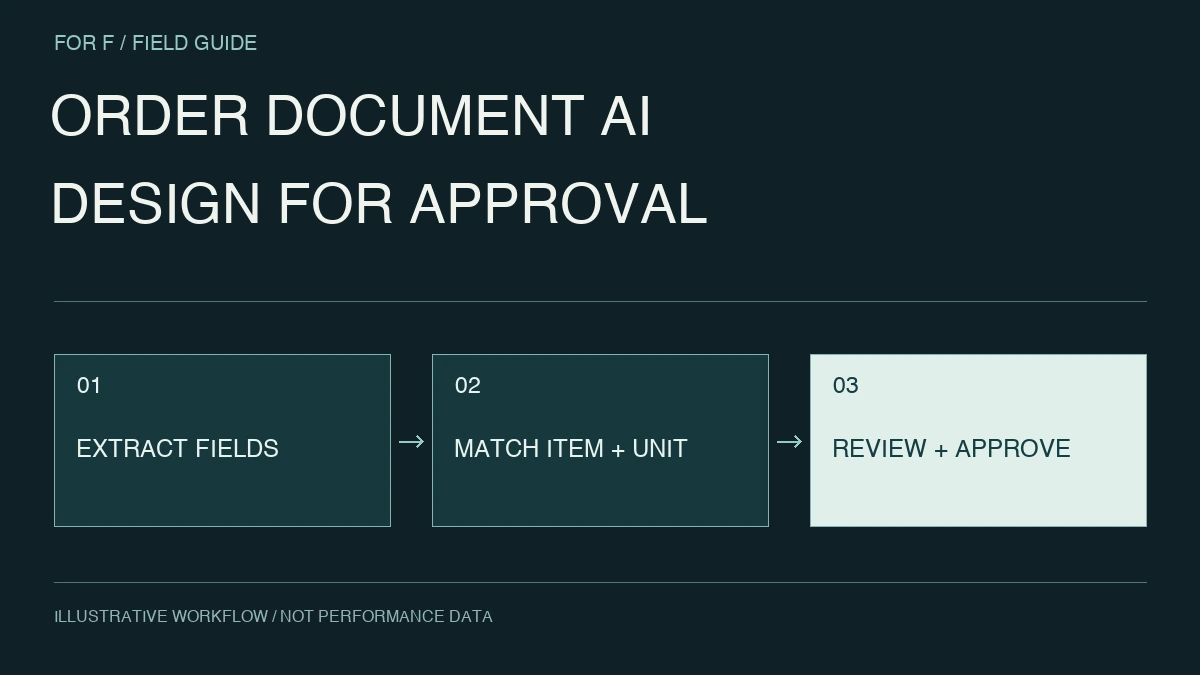
Wholesale order automation includes product matching, packs, amendments and approval. Define evaluation and integration that reduce entry effort without creating incorrect orders.
Read the guide ↗YOUR OPERATION / OUR STARTING POINT
Tell us about the workflow, systems and reporting or documents that need attention. We will define a suitable phase, deliverables and assumptions.
Wholesale and trading — discuss your project How scope and estimates work ↗