 RETAIL & COMMERCE / CAPABILITY
Match buying decisions
Choose SKU, site and weekly units that fit ordering. Separate sparse and new items.
 TECHNOLOGY & DESIGN
RETAIL & COMMERCE / CAPABILITY
Evaluate forecasts using sales, stockouts, promotions and lead times. Show uncertainty and retain the reasons for buyer adjustments.
Explore the delivery scope ↓Conceptual data-to-operation flow, adapted to the agreed project scope.
Zero sales can indicate no demand or unavailable stock. Distinguish availability from demand before training on sales counts.
THE SHORT ANSWER
Evaluate forecasts using sales, stockouts, promotions and lead times. Show uncertainty and retain the reasons for buyer adjustments.
DESIGN & DELIVERY
Choose SKU, site and weekly units that fit ordering. Separate sparse and new items.
Compare against last week, seasonal patterns or moving averages before choosing complexity.
Include lead time, pack size, minimum orders and storage limits, with agreed stockout and overstock tradeoffs.
DATA READINESS
A consistent format does not ensure operational usefulness. Confirm meaning, refresh and exceptions with owners, and keep missing information explicit.
| Data | Required fields | Checks |
|---|---|---|
| Sales history | Date, SKU and quantity | Closures, stockouts and discontinued items |
| Promotion | Price, campaigns and events | Whether information was known at forecast time |
| Procurement | Lead times and minimums | Delays and partial deliveries |
EVALUATION
These are candidate evaluation measures. Establish a baseline and agree on data, period, targets and exclusions before work starts. They are not claimed performance results.
| Measure | Evaluation method |
|---|---|
| Forecast error | Compare with baseline by category and volume |
| Stockout and excess | Evaluate under equal replenishment assumptions and explicit costs |
| Adjustment burden | Track buyer changes and their reasons |
Begin with recommendations approved by buyers. Seasonal evaluation requires sufficient historical coverage.
Review data mappings, workflow, prototype and evaluation evidence before choosing production scope. Estimates distinguish assumptions because permissions and interface terms affect implementation.
Select one category and channel for reporting or weekly forecasting.
QUESTIONS BEFORE YOU START
We assess product identifiers, returns and available fields; CSV exports can be a starting point.
Limited observations make evaluation unstable. Compare category-level forecasts, replenishment rules and buyer judgement.
RELATED FIELD GUIDE
RETAIL & COMMERCE / GUIDE
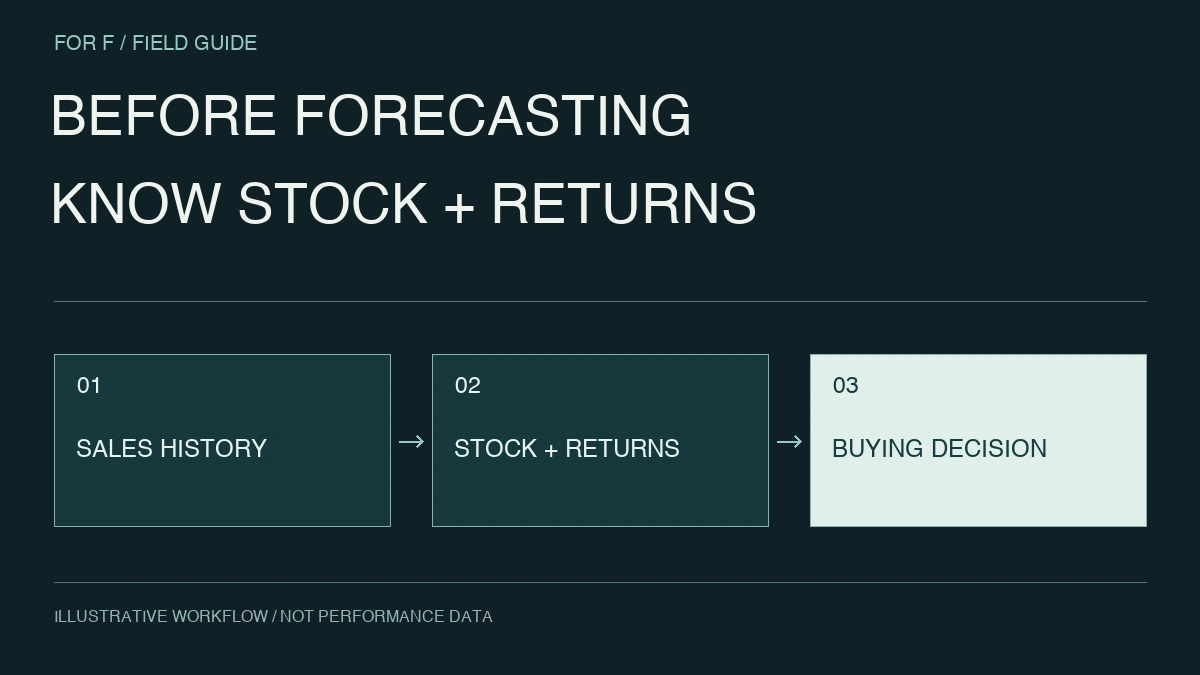
Sales history alone does not make a forecast useful for buying. Distinguish why sales were absent, what was known at prediction time and the constraints of ordering.
Read the guide ↗YOUR OPERATION / OUR STARTING POINT
Tell us about the workflow, systems and reporting or documents that need attention. We will define a suitable phase, deliverables and assumptions.
Retail and e-commerce — discuss your project How scope and estimates work ↗