 RETAIL & COMMERCE / BUILD & OPERATE
Product changes
Update mappings for launches, bundles and retirement; define forecast exclusions.
 TECHNOLOGY & DESIGN
RETAIL & COMMERCE / BUILD & OPERATE
Confirm refresh schedules and API constraints for commerce, POS and stock systems. Retain history for cancellations, returns and product merges.
Explore the delivery scope ↓Conceptual data-to-operation flow, adapted to the agreed project scope.
Confirm refresh schedules and API constraints for commerce, POS and stock systems. Retain history for cancellations, returns and product merges.
Update mappings for launches, bundles and retirement; define forecast exclusions.
Separate live reporting from accounting close and control recalculation.
Validate with buyers in one category before expanding across stores or channels.
PRODUCTION SCOPE
| Scope | Industry context | Agreement |
|---|---|---|
| Data integration | POS and online orders / Stock, movements and returns / Ad spend and product costs | Refresh, retry, deduplication and reconciliation |
| Interfaces and access | Planning, merchandising, e-commerce, marketing and IT | Read, edit and approve permissions with activity records |
| Migration and acceptance | Select one category and channel for reporting or weekly forecasting. | Parallel verification, scoped record counts and rollback |
ARCHITECTURE CHOICES
Compare extending existing databases and business tools with cloud foundations including Snowflake and Google Cloud. Evaluate volume, refresh, access, interfaces and operating cost before choosing products.
Ingest and reconcile operating records before deciding whether write-back is needed.
Show failed refreshes, unmatched data and pending reviews with source and recovery paths.
Separate compute, storage and API cost drivers and agree on refresh and usage scope.
RELEASE READINESS
Can buyers spend less time reconciling information and explain their buying decisions?
Test missing or late data, integration failures and unavailable owners, including notifications, recovery and manual fallback.
Agree on architecture, configuration, access, refresh and recovery documentation, with defined monitoring hours and improvement scope.
Interfaces, export terms, volumes, history, users, permissions and timing make estimates concrete. If these are unknown, scope discovery as an initial engagement.
Channels introduce different product identifiers and revenue cutoffs. Distinguish sales growth from contribution after discounts, returns and fulfilment costs.
QUESTIONS BEFORE YOU START
We assess product identifiers, returns and available fields; CSV exports can be a starting point.
Limited observations make evaluation unstable. Compare category-level forecasts, replenishment rules and buyer judgement.
RELATED FIELD GUIDE
RETAIL & COMMERCE / GUIDE
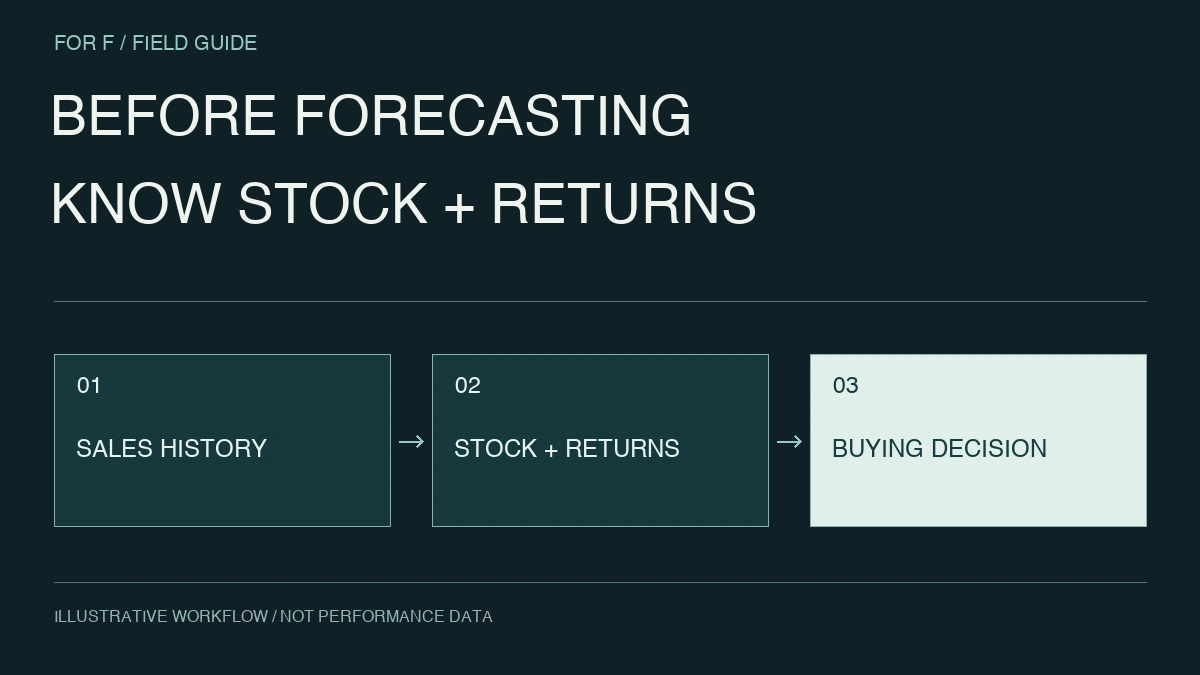
Sales history alone does not make a forecast useful for buying. Distinguish why sales were absent, what was known at prediction time and the constraints of ordering.
Read the guide ↗YOUR OPERATION / OUR STARTING POINT
Tell us about the workflow, systems and reporting or documents that need attention. We will define a suitable phase, deliverables and assumptions.
Retail and e-commerce — discuss your project How scope and estimates work ↗