
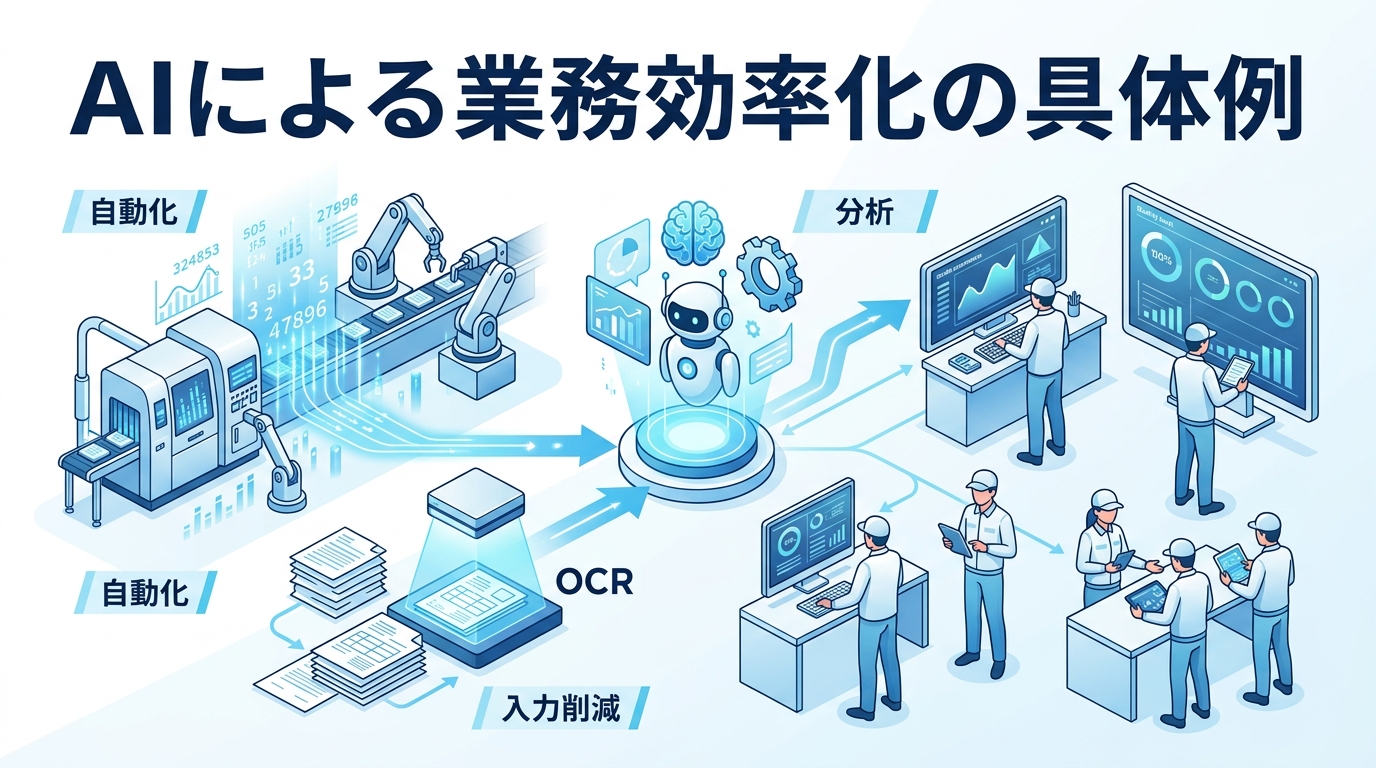
A practical view of GCP and AI for manufacturing workflows, including data entry, customer analysis, inquiry handling and stable operations, with a PoC as a possible starting point.
Manufacturing workflows may have evolved over years, yet paper and Excel often leave room for improvement. Common concerns include unused data and knowledge that is difficult to hand over.
Digital transformation offers ways to address these challenges, but companies may be unsure where to begin or whether staff will use a new system.
"We have data, but are not using it."
"We know there is room to improve, but daily work leaves little time to start."
This article introducesoperational improvements in manufacturing using Google Cloud and AIthrough practical examples.
Challenges in manufacturing
Consider some common operational challenges.
First, paper and Excel records can make daily reports, work logs and inventory hard to reconcile. Aggregation takes time, and entry errors and missed updates are common risks.
Second, work can depend on specific individuals. When only one person understands a process, handover and training take longer and team productivity suffers.
Third, accumulated data often remains disconnected from analysis and decision-making.
Daily pressures can postpone these issues, but the longer-term cost can be significant.
Examples of AI-assisted operational improvement
What improvements can AI support?
Reduce data-entry workload and errors
Entering work logs and inspection data can burden frontline teams. AI and system integrations can reduce the amount of manual input.
For example, IoT integrations can collect work data automatically, while document recognition can digitize forms. These approaches can reduce manual entry and associated errors.
Create room for higher-value work
Automation aims to create capacity for more important work, beyond reducing task counts.
Staff who previously spent time entering and checking records can focus on quality and process improvements, supporting wider productivity gains.
Better decisions using customer data
Manufacturing operations continually generate order, inventory and shipment data.
Automated customer data analysis with AI
Consolidating data in services such as BigQuery and applying AI can help reveal previously hidden patterns.
Examples include visualizing seasonal product demand and repeat purchasing by customer.
Support experience with data-driven decisions
Data can complement experience and intuition, helping teams manage inventory imbalance and improve production planning.
This can reduce waste and missed opportunities.
Faster inquiry handling through automation
Manufacturers handle recurring internal and external questions, including parts availability and specifications.
AI chatbots and automated responses
AI chatbots can respond to supported common questions quickly and reduce the workload on staff.
More consistent responses and customer experience
Standardized response handling can reduce variation between staff and support customer satisfaction.
Load balancing and reliable operations with Google Cloud
A frequently overlooked question is whether the system will remain usable over time.
Google Cloud load balancing can distribute traffic during demand spikes. Autoscaling can adjust resources to changing usage.
These capabilities can help manage seasonal or unexpected load and reduce interruption risks. Reliability matters particularly where system interruptions can affect production.
How digital transformation changes the workplace
Consider the implications for frontline operations.
Manual entry and checking consume time, while data remains underused. Unreliable systems can also obstruct work.
A well-implemented transformation can automate entry, make information accessible, support decisions with analytics and improve operating reliability.
Small improvements in daily work can accumulate into meaningful productivity gains.
Automation should increase the value people can contribute
Finally, consider the purpose of automation.
The aim is to help people apply their skills where they matter, by reducing repetitive work.
Creating capacity for judgment and improvement can strengthen a company's competitiveness.
Manufacturing transformation does not need to happen all at once. Start with a focused improvement and expand in stages.
For f supports operational system development with Google Cloud and AI, from requirements through operations. You can begin with a PoC or an initial discussion.

Updated September 7, 2026 | From manufacturing AI validation to production
Start the first PoC with one workflow
Addressing many manufacturing issues at once complicates measurement and coordination. For f proposes a focused scope that allows before-and-after comparison, such as report transcription, record search or inquiry classification. Automation affecting equipment or quality decisions needs human review appropriate to its impact.
Five points to define before starting
- Target workflow:Who performs which tasks, and how often?
- Current baseline:How will processing time, checks, rework and volumes be recorded?
- Evaluation data:Will it include missing values, inconsistent notation and exceptions as well as ordinary cases?
- Review ownership:Who checks AI outputs, and what happens when a decision cannot be made?
- End-of-trial decision:What conditions determine development, further testing or stopping?
An answer alone is not a pass
For generative AI, evaluate appropriateness, grounding, correction workload, latency and usage cost separately. Model selection and operational monitoring serve different purposes. Google Cloud's evaluation documentation describes using datasets and metrics to assess models and applications.Google Cloud: official generative AI evaluation documentation
Deliverables for a production decision
Alongside the prototype, document results, failures, unresolved issues, intended operations and the next development scope. Even a highly accurate system can stall without owners for data updates and support. Connect evaluation results to operational design.
For f offersAI and data analytics supportandPoC and prototypes. If the workflow or data is not yet clearly defined,talk to us.