
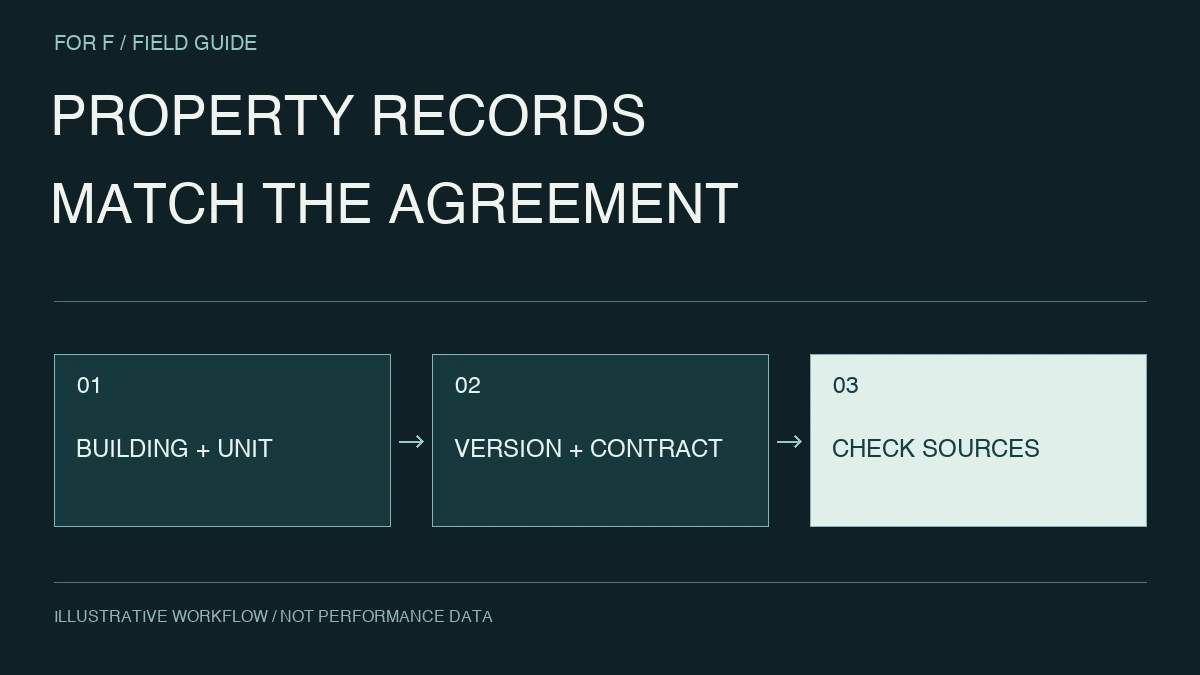
KEY TAKEAWAY
Bound retrieval by property, contract and permission and show source versions. Test abstention for missing information as well as mistakes involving similar properties or old rules.
1. An address is not a sufficient key
Multiple buildings can share an address, and one property can have several address spellings. Unit numbers repeat across buildings. Identify property, building, unit and agreement separately and manage their relationships.
If renamed or formerly managed properties remain in history, distinguish them from current scope.
2. The last saved file is not always authoritative
File timestamps differ from legal or operational effective dates. Record issuer, version, validity and review status rather than assuming the newest upload is authoritative.
Replacing a file also requires retrieval-index updates. Track whether answers still depend on old content during the refresh interval.
3. Review the answer beside the original
An answer without evidence forces staff to start the search again. Show property, document, version and relevant passage beside the draft, with access to the original.
Conditions in tables and notes may change the meaning of an excerpt. Provide surrounding context so staff can assess the summary.
4. Test questions without an answer
Ask about absent facilities and different unit conditions to test unsupported inference. Conflicting documents should trigger review rather than silent selection.
Separate supported answers, appropriate abstentions, wrong references and unsupported claims. Answering every question is not the right quality target.
5. Enforce permissions on retrieval and originals
Hiding data in an answer is insufficient if its source link exposes another contract. Check retrieval, answers, attachments and logs, including access changes after transfers or management termination.
Limit personal fields where not needed. Keep AI roles explicit as retrieval, extraction and drafting with responsible human confirmation.
6. Validate a bounded property group
Choose one portfolio and document type with example questions, expected sources and abstention conditions. Measure time through source verification.
For f can scope register preparation and knowledge evaluation, preserving confirmation of formal contractual and regulated matters by qualified, responsible staff.
A concrete acceptance check
Verify neighbouring units and contract transitions. Confirm that out-of-scope agreements and personal data remain hidden and unresolved enquiries are not dropped.
Before commissioning
- Separate property, building, unit and agreement.
- Keep effective dates and review states.
- Test wrong-property, old-version and unsupported questions.
- Apply access rules to source links and logs.