 CONSTRUCTION / BUILD & OPERATE
Project lifecycle
Define access at startup, closeout freeze and handover ownership.
 TECHNOLOGY & DESIGN
CONSTRUCTION / BUILD & OPERATE
Align project registers and document stores, define subcontractor access and post-project retention, and design submission retries for site connectivity.
Explore the delivery scope ↓Conceptual data-to-operation flow, adapted to the agreed project scope.
Align project registers and document stores, define subcontractor access and post-project retention, and design submission retries for site connectivity.
Define access at startup, closeout freeze and handover ownership.
Refresh retrieval indexes and track answers tied to old documents.
Separate new and active projects, with site onboarding and support ownership.
PRODUCTION SCOPE
| Scope | Industry context | Agreement |
|---|---|---|
| Data integration | Project registers and budgets / Daily reports, photos and schedules / Orders, invoices and revisions | Refresh, retry, deduplication and reconciliation |
| Interfaces and access | Project delivery, site managers, estimating, procurement, finance and IT | Read, edit and approve permissions with activity records |
| Migration and acceptance | Choose one document type or one cost work package within a project. | Parallel verification, scoped record counts and rollback |
ARCHITECTURE CHOICES
Compare extending existing databases and business tools with cloud foundations including Snowflake and Google Cloud. Evaluate volume, refresh, access, interfaces and operating cost before choosing products.
Ingest and reconcile operating records before deciding whether write-back is needed.
Show failed refreshes, unmatched data and pending reviews with source and recovery paths.
Separate compute, storage and API cost drivers and agree on refresh and usage scope.
RELEASE READINESS
Can evidence and revisions be shared without increasing site reporting effort?
Test missing or late data, integration failures and unavailable owners, including notifications, recovery and manual fallback.
Agree on architecture, configuration, access, refresh and recovery documentation, with defined monitoring hours and improvement scope.
Interfaces, export terms, volumes, history, users, permissions and timing make estimates concrete. If these are unknown, scope discovery as an initial engagement.
Documents and subcontractors vary by project. Define project IDs, work packages, revisions and approval states, while keeping reporting practical for the site.
QUESTIONS BEFORE YOU START
Yes, using registers, reports, spreadsheets and PDFs. Model integration requires a separate scope and data-access review.
Start with read-only reporting after assessing disruption; preserve agreed submission and approval procedures.
RELATED FIELD GUIDE
CONSTRUCTION / GUIDE
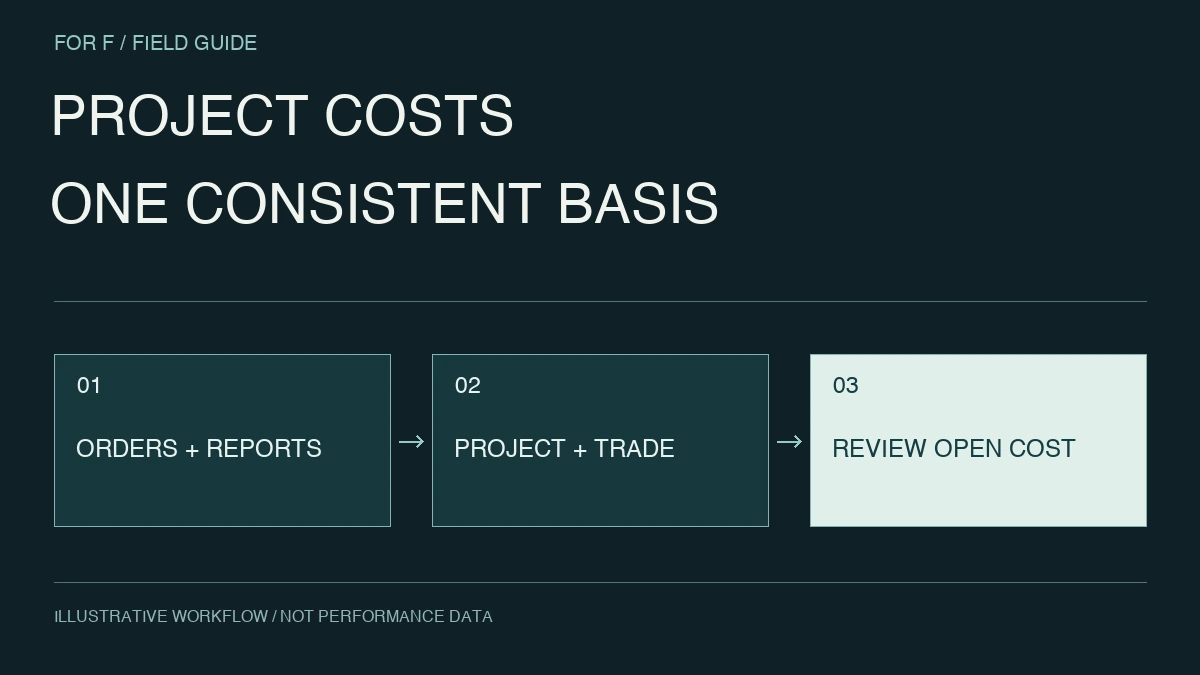
Before moving a project register into a dashboard, distinguish commitments, payments, additional scope and budget revisions. Build figures that sites and head office can reconcile.
Read the guide ↗YOUR OPERATION / OUR STARTING POINT
Tell us about the workflow, systems and reporting or documents that need attention. We will define a suitable phase, deliverables and assumptions.
Construction and installation — discuss your project How scope and estimates work ↗