 LOGISTICS / PROVE
Include peak days
Evaluate concentrated workloads and frequent booking changes.
 TECHNOLOGY & DESIGN
LOGISTICS / PROVE
Validate one site and a defined period of dispatch or waiting records. Can the team reduce reconciliation under comparable orders and site conditions?
Explore the delivery scope ↓Conceptual data-to-operation flow, adapted to the agreed project scope.
THE DECISION TO MAKE
Validate one site and a defined period of dispatch or waiting records.
A PoC should produce evidence for the next investment decision. Business owners, data owners and users agree on normal tasks and exceptions, rather than treating a working screen as proof of value.
INDUSTRY-SPECIFIC TESTS
Evaluate concentrated workloads and frequent booking changes.
Include re-entry, repeated deliveries, same-day additions and missing fields.
Compare individual visits with source records and explain differences.
BASELINE & ACCEPTANCE
| Candidate measure | Method |
|---|---|
| Event completeness | Visits with all required events divided by in-scope visits |
| Reconciliation effort | Dispatch and site time spent matching records |
| Dwell distribution | Median and long-tail stays for comparable trips |
| Candidate measure | Method |
|---|---|
| Feasibility | Share of proposed plans meeting agreed hard constraints |
| Replanning effort | Time needed to turn a proposal into a usable plan |
| Plan versus actual | Compare delay, driving and waiting separately |
Set targets from your own baseline. Hold evaluation evidence separate from tuning and fix the assessment period and scope. Record failures, abstentions and untested conditions alongside successes.
GO / REVISE / STOP
If events are inconsistent, revise capture definitions. If plans violate operating constraints, revisit the constraint inventory.
Core criteria pass, with owners, interfaces and remaining issues understood.
There is a promising signal but insufficient coverage; define a bounded follow-up.
Value does not exceed the baseline; compare data cleanup or improvements to existing tools.
The PoC scope defines the workflow, source material, environment, evaluation and prototype/report deliverables. Production development is a separate decision.
QUESTIONS BEFORE YOU START
No. Begin with read-only analysis; design write-back separately after confirming interfaces and responsibilities.
Measure current completeness and review effort, then agree on comparable metrics rather than adopting national averages as targets.
RELATED FIELD GUIDE
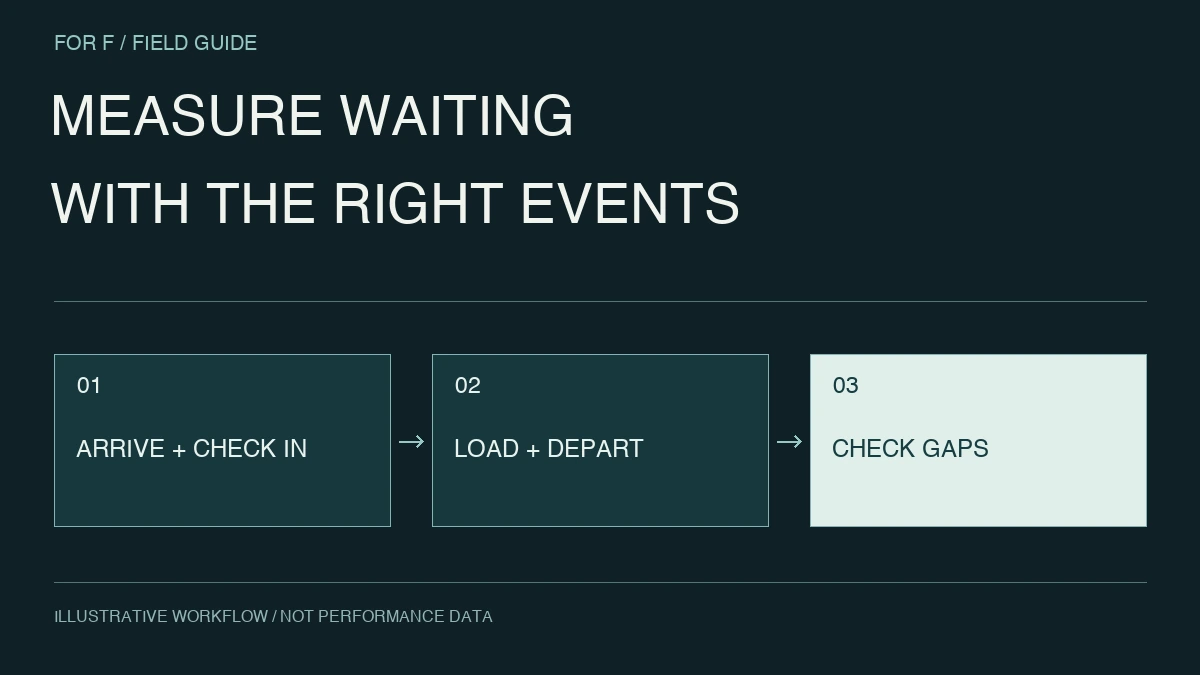
LOGISTICS / GUIDE
Before using a single arrival-to-departure duration, agree on reception, waiting and handling events. Build evidence that shippers and operating teams can use together.
Read the guide ↗YOUR OPERATION / OUR STARTING POINT
Tell us about the workflow, systems and reporting or documents that need attention. We will define a suitable phase, deliverables and assumptions.
Logistics and transport — discuss your project How scope and estimates work ↗